

Kodak miscellaneous:
Kodak Autotime Scale model A from 1910-1915


The Kodak Autotime Scales were an early attempt to provide a method for amateur photographers to set proper exposure settings. The set consists of scales that are attached to the shutter, giving guideline settings for both shutter and lens aperture.
Kodalux L Lightmeter (Germany) mid '50

The Kodalux L model was made by Gossen (and sold at the same time as the Gossen Sixti). It's meant for Kodak Retina cameras but it would fit on anything with an accessory shoe. There was another Kodalux L model (also for Retinas) which later became the Gossen Pilot.
Simple enough to operate: there's a knob on the back end that turns a little cylinder in the meter face. The cylinder is painted with little stripes, and a different stripe shows depending on what position the knob is in. This is geared to another drum that has ƒ/stops. So You aim the meter and turn the knob until the little stripe is underneath the needle, and then read the combinations on the right-hand side.
Eastman Color Temperature meter, USA 1940 (nr 1139)

This is very similar to the Harrison Light Corrector, albiet a little more complicated. You peer through it at a light source, and the field of view is split in half. One side is yellow, the other is red or green, depending on the position the of filter. You turn the knob until the color on either side of the line appears to be about the same, then read the number on the dial. Multiply it by 100 and that's the color temperature in degrees Kelvin. You can then figure out which camera filters to use to correct the light.
Kodak Lighting set for the Retina Copying stand

Retina Lighting Unit for Table Top Stand with its proper box. The two black, silver tipped arms are screwed into the side of the stand and the lights mounted so as to provide for 45 degree shadowless illumination of the documents being photographed.
Kodalux L Lightmeter (Germany) mid '50

Kodalux L Exposure Meters- Kodak manufactured at least two different clip-on exposure meters for the Retina cameras without built-in meters. Both meters displayed can read either incident (white baffles in place) or reflected light (baffles opened). Shown with their leather cases.
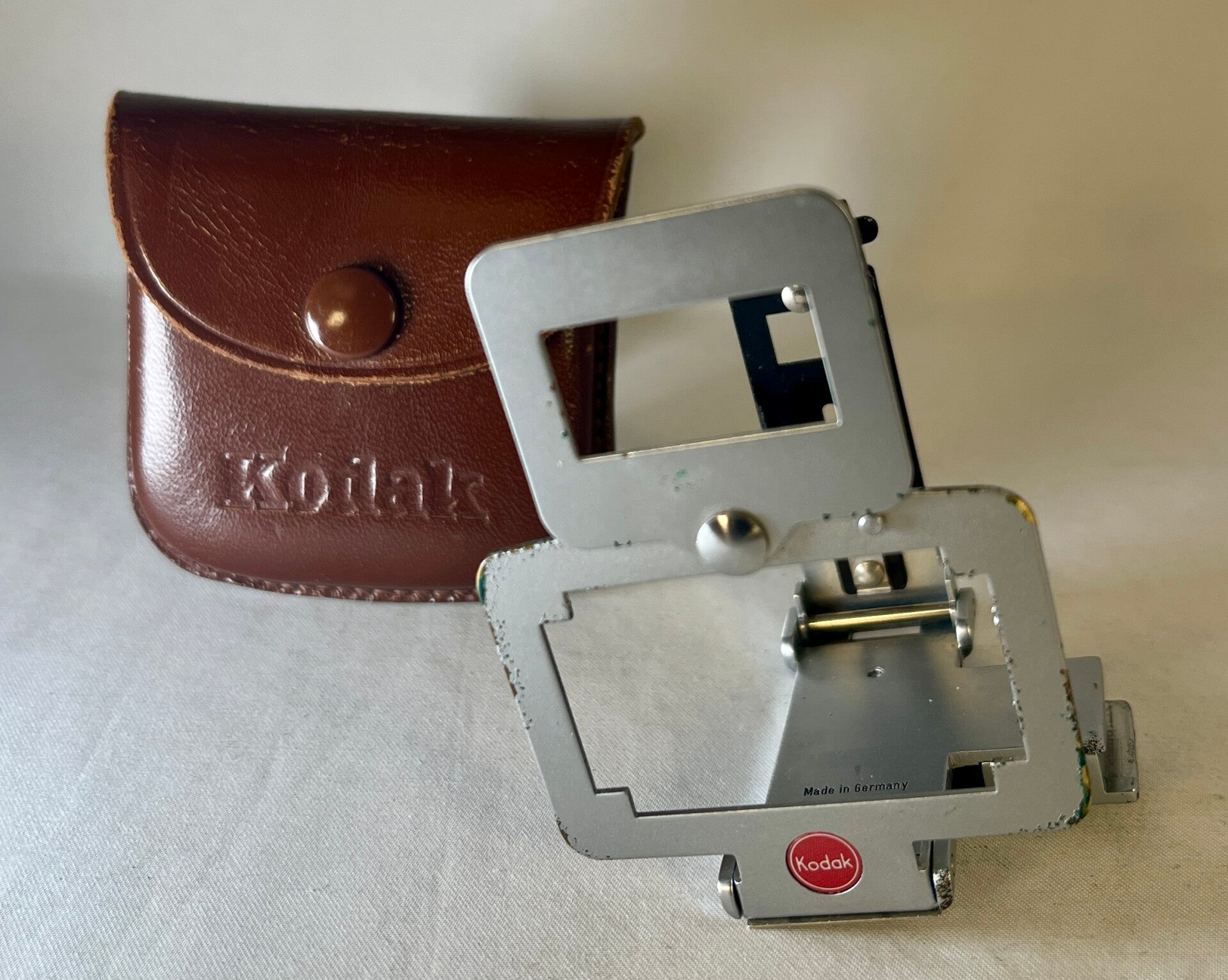
Kodak Germany Slide Holder

This is a vintage Kodak slide holder (Diahalter zum Nahstativ 1:1 / Slide Holder for close-up tripod 1:1). This specific tool was produced by Kodak AG in Stuttgart-Wangen (Germany) and was intended as an accessory for macro or reproduction photography with vintage Kodak Retina cameras.
Kodak Retina Sports Finder (Germany)
This object is a vintage Kodak Retina Sports Finder (also known as a window viewfinder or sports finder), produced in Germany by Kodak AG.
This folding metal attachment was used in the 1950s and 60s as an external viewfinder for classic rangefinder cameras, particularly the Kodak Retina IIc, IIIc, and IIIC . It helps photographers quickly frame and compose action or sports shots, especially when using the optional 50mm or 80mm lenses. The set is complete with the accompanying original brown leather storage pouch featuring the embossed Kodak logo.
Kodak Tischstativ

his is a vintage Kodak Tischstativ (table tripod/reproduction tripod), specifically designed for the famous German Kodak Retina Ib, IIc, and IIIc rangefinder cameras from the 1950s. It is a modular system in the original yellow box. This allowed the camera to be placed stably on a table for, for example, macro photography, close-ups, or photographing documents (reproduction).
Kodak Germany Close-up Attachment diverend sizes


This is a vintage Kodak Nahaufnahme-Ansatz Einstellstäbe box, a set of tools for macro or close-up photography. This specific box is intended for a 1:2, 1:3, 1:4,5 & 1:1,5 magnification factor. It was produced in the 1950s by Kodak AG in Stuttgart-Wangen, Germany.
Kodak Germany: Plate for Document Stativ Din A4 & Din A5


It is a specific photo accessory that was used in combination with a Dokumentenstativ (document stand or reproduction stand), such as those for the classic Kodak Retina cameras from Germany.
Kodak Polycontrast Filter Kit model II

This is a Kodak Polycontrast II Filter Kit, a vintage accessory set used in the analog darkroom for black-and-white photography. Etsy +1 The set is intended for use with an enlarger. With these colored filters (which are placed in the holder below or above the lens), the photographer can control the contrast range and tonal scale when printing on variable contrast photo paper.
Kodak K-100 viewfinder lens

This is a vintage Cine-Kodak K-100 Viewfinder Lens made by the Eastman Kodak Company (E.K.Co.), specifically a 75mm variant. Du-All Camera. This type of lens was used in the 1950s on Kodak K-100 16mm film cameras (particularly on the versions with a rotating lens head or turret). They did not serve to project the image onto the film, but were placed in the viewfinder so that the filmmaker could see through the camera exactly the same angle of view as the 75mm main lens on that camera.…
Sunhead and Filters for Retina

This is an original vintage Kodak Retina filter set in the distinctive brown plastic storage case, complete with the matching lens hood in the lid. Raffles House Preschool. These specific sets were made in the 1950s and 1960s for the well-known Kodak Retina rangefinder cameras (such as the Retina IIc, IIIc, and Reflex models).
Kodak Polycontrast Filter Kit model A

This is a vintage Kodak Polycontrast Filter Kit (Model A). This is a classic set of darkroom equipment from analog photography, primarily used in the 1950s and 1960s.
Kodak Safelight Wratten filter 6B

This is the original packaging of a vintage Kodak Wratten Series 6B Safelight Filter, This filter is specifically designed for use in the photography darkroom particularly for the safe processing of blue-sensitive X-ray films and specific industrial films and papers. The filter has a distinctive brown or amber glow. As a result, it only allows light waves to pass through that the blue-sensitive film layer does not react to, so that the photographer or technician has visibility without exposing or damaging the film.
Kodak slippers / flip flops

These are vintage promotional flip-flops from Kodak Images, finished in the recognizable retro corporate colors: yellow, red, and blue. Flip-flops like these were often issued as merchandise or business gifts during Kodak marketing campaigns.
Emmett Kelly, Jr. at the Kodak World's Fair Pavilion 1964

This collectible is the hand-painted porcelain figurine "Kodak's Clown" by Emmett Kelly Jr., released by Flambro. The figurine commemorates the 1964 New York World's Fair, where the famous street clown Emmett Kelly Jr. performed as the official live entertainer and advertising magnet at the Kodak Pavilion. It depicts the character 'Weary Willie' with a camera in his hand, standing next to an advertising column reading "Get your picture taken at the Kodak Pavilion".
Kodak Musum Harrow mok

Kodak Museum Harrow: In 1927, a museum was opened at the site. The 1947 published book The Kodak Museum, A Permanent Exhibition Illustrating the History of Photography and Some of its Applications in Science, Art and Industry is an illustrated catalog of the collection at the Kodak Museum.The museum at Harrow closed in 1985; the items are now at the National Science and Media Museum
Kodak Tin 1997 Edition

This is a vintage Kodak collector's tin , named "The KODAK Memories Collection Holiday Commemorative Tin, 1997 Edition" .
The tin was issued as a special holiday edition and is decorated with nostalgic images in the distinctive Kodak yellow and red. The lid features Christmas scenes with children in red pajamas, along with images of vintage film rolls and a classic camera on the side.
At the time, such tins were often sold in combination with film rolls or as a separate storage tin for photography enthusiasts. Nowadays, it is a beloved item among collectors of camera memorabilia
Kodak Tin 1994 Edition

This is a collectible from Eastman Kodak named "The Kodak film memories collection – Holiday Commemorative, Number One" This specific package was released in 1994 and was intended as a special Christmas edition. It contains a cardboard sleeve with a classic red and gold metal storage tin
Kodak Tin 1995 Edition

This is a vintage Kodak tin from 1995 , released as a special Christmas edition ("Happy Holidays") in collaboration with Disney's "It's a Small World" attraction, Originally, this tin was sold as part of a festive gift set containing film rolls (such as Kodak Gold 35mm film). The top of the tin is decorated with the characteristic, cheerful illustration style of the world-famous Disney attraction. Today, it is a beloved collector's item for both Disney and photography enthusiasts
Kodak Tin Cinderella 1995 Edition

This is a Walt Disney's Cinderella Commemorative Holiday Tin from 1995, released in collaboration with Kodak. This vintage collector's tin was sold at the time as a special holiday gift package ("Capture the Magic of the Moment") and originally contained rolls of Kodak photographic film. The lid features a classic image of Cinderella and the Prince, along with Lucifer the cat and the mice Jaq and Gus.
Kodak Tin Toy Story 1996 Edition

This is the Kodak Toy Story Commemorative Holiday Tin promotional packaging from 1996. What does this package include? This retro collectible was released to promote the very first Toy Story film. The cardboard outer box (the sleeve) contains a special offer Tin storage box: An exclusive metal storage tin (Commemorative Tin) with a colorful image of Woody, Buzz Lightyear, and Rex.
Kodak Tinnen/ pewter plate 100 years 1980

This object is a vintage pewter Kodak collector's sign, released in 1980 to commemorate the 100th anniversary of the Eastman Kodak Company (1880–1980). The sign was manufactured in the United States at the time by the well-known pewter producer Wilton Armetal.
Kodak Mask for glass Slides 2x2 inch

This is a vintage, bright yellow box of Kodak Masks for Glass Slides, produced by the Eastman Kodak Company. eBay These cardboard masks were used for mounting slides at home. Photographs or negatives were neatly framed between two 2 x 2 inch (5.1 x 5.1 cm) glass plates using these, so that they could then be projected crease-free and dust-free.
Kodak Wide angle converter

This is the original packaging of a vintage Kodak Wide Angle Converter lens adapter. This accessory was specifically designed for the Kodak Brownie 8mm film cameras with an f/2.7 or f/1.9 lens set. The adapter converts the standard focal length of 13mm to a 9mm wide-angle image, giving the filmmaker a wider field of view without having to purchase a completely new lens.
Kodak Brownie postcard 1900-1910

his is a beautiful antique New Year's card from the early 20th century (circa 1900-1910). The illustrated postcard shows a seated boy wearing a cap, A Brownie accompanied by a small dog. To the right behind him stands a large number 1, symbolizing January 1st, the start of the new year. The image is elegantly framed with holly branches, and at the bottom, in vintage typography, is the English text: "I wish you a Happy New Year".
Kodak Brownie christmas ornament
Kodak Bromure, France

New in box from the Sundance Catalog is a "Kodak Brownie Holiday Flash Ornament - with a See-Through Lens". This is a glass Christmas ornament in the shape of a Kodak Brownie. The front of the ornament says "Kodak - Dakon Lens - Brownie Holiday Flash Camera". This is not a working camera nor does it have a flash - it is a glass ornament made to replicate the Kodak Brownie camera. When you look through the view finder, you can see through to the other side. Also you can see light through the red back portion that is behind the lens. It has a metal crimp top that you can run a ribbon through for hanging on your tree. The ornament is black with gray and silver accents. It measures about 3-1/4" wide by 2-1/4" deep and about 3-1/2" tall to the top of the hanging loop. The side of the box reads: "The camera that captured a nation, a million memories of holidays past, moments large and not-so, memorialized in exquisitely detailed hadn-painted, mouth blown glass.

This is a vintage packaging of Kodak photographic paper (Bromure "Kodak"), specifically designed for the so-called "petit format" (35mm or amateur format). The French text on the box provides instructions for amateur photographers. Among other things, it states that the film was developed in the fine-grain developer "Kodatol", a well-known chemical developer from Kodak from the mid-20th century.
Kodak Brownie Member card1940
Kodak Razor

This is a historical membership certificate or registration card for the Kodak Brownie Photo and Film Club. Here is a brief summary of what is on the card: Free membership: Purchasers of a Kodak Brownie camera or film camera automatically became members.

the Kodak Max Premium Razor 5 shaving system. This is a premium razor from Kodak that comes with a non-slip rubber handle and a set of 4 refill blades (cartridges).
Kodak Button

this shows a vintage promotional badge (pin) with the world-famous Kodak advertising slogan : "You Press the Button, We Do the Rest"
Kodak compact camera stand model 2

This is a vintage Kodak compact camera stand, model 2, a compact tabletop tripod base produced by Kodak. Features & Operation Purpose: This heavy, stable base serves as a compact tabletop tripod to take vibration-free photos. As indicated on the yellow box, it is particularly useful for cameras with electronic shutters.
Kodak Cortesia Sign

This object is a vintage cardboard Kodak advertising sign , specifically designed as a promotional bumper protector or license plate attachment for cars. Such promotional items were given away by Kodak in Spanish-speaking countries in the 1950s and 1960s as business gifts through local photo shops to build brand loyalty and subtly advertise on public roads.
Kodak Cresta2 rubber stamp

This is a vintage wooden printing block (cliché) with a metal or linoleum stamping surface, used in traditional letterpress printing. The image on the block shows a classic Kodak Brownie 127 camera from the 1950s. Because it is a stamp used for printing, the image (and the brand name under the lens) is in mirror image.
Kodak Cosmos clips, UK

These are vintage Kodak Cosmos Clips, produced by Kodak Ltd. in London. Etsy. These metal clips were used in early photography in the darkroom for washing and hanging photographic prints and films.
Kodak Display Box

This object is a vintage Kodak counter display case from the twentieth century, which was used in photo shops at the time to display cameras or accessories dust-free.
Kodak Brownie Darkroom lamp kit model B 1954-1956
Kodak Brownie Model-D Darkroom Safelight Lamp 1940-1960

This is the vintage Kodak Brownie Darkroom Lamp Kit (Model B). This type of darkroom lamp (safelight) was used in analog photography to process photographic paper and films without damaging them with normal white light. The Kodak Brownie Darkroom Lamp Kit (Model B) was introduced and produced in the 1950s (circa 1954–1956).
Kodak Beehive Safelamp UK 1950

The classic Kodak Model A ("bullet" or "beehive") Safelight simply screws into an existing wall or ceiling lamp socket, or may be used with a socket and clamp set to allow adjustable positioning. These safelights are supplied with a 5½" diameter 1A-type red filter, suitable for use with most Kodak B&W photographic papers and certain graphic arts materials. Optional filters for other photographic materials are available. Please refer to the product data sheet packed with the material you are using to determine the recommended safelight filter.

This item is a vintage Kodak Brownie Safelight Lamp (Model D) with accompanying darkroom filters. This device was produced by the Eastman Kodak Company for use in the photographic darkroom. Instead of using a regular bulb, photographers screwed this safelight directly into a standard ceiling or wall socket. Years 40-50
Kodak Safelamp UK 1940-1950

This object is a vintage Kodak Darkroom Lamp (Model A). It is a classic darkroom lamp used by photographers during photo development. The Kodak Darkroom Lamp (Model A) was introduced in the 1940s (circa 1940-1945) and was produced well into the 1950s.
Kodak Brownie Dark Room Lamp model A, 1934-1935

This is a vintage Kodak Brownie Dark Room Lamp Model A, produced by the Eastman Kodak Company in Rochester, New York. This is a so-called safelight (dokulamp). The red paper or cardboard shade filters the light, allowing photographers to safely develop black-and-white photographic paper and negatives in the darkroom without exposing the material. The Kodak Brownie Darkroom Lamp Model A was introduced in the 1930s (around 1934-1935).
Kodak Disc advertising stand 1970
Kodak Dia souvenirs

This is a vintage Plastic counter display from Kodak from the 1970s, specially designed for the Dutch market. Features of the display Design: The display is shaped like a hand holding up the thumb and index finger to demonstrate the thickness or compactness of a compact camera (such as the then-popular Kodak Pocket Instamatic).

This is a vintage set of 6 SCALA color slide reels (slides), produced on Kodak Eastmancolor film. Such sets were produced on a large scale from the 1960s through the 1980s by the Italian publisher SCALA (Istituto Fotografico Editoriale). They were sold as tourist souvenirs at museums, historical sites, and in Italian cities. The white boxes at the bottom of the packaging were used to mark the specific city or landmark.…
Kodak Brownie envelop 2000

Kodak Brownie envelop 2000

This is a special First Day Cover celebrating the 100th anniversary of the Kodak Brownie camera.
Kodak Filmcans

more types, to much to set here, The image shows vintage metal Kodak 35mm film roll cases from the 1940s or 1950s. These characteristic aluminum tubes with screw lids were used to protect photographic film (such as Kodachrome or Tri-X) from light and moisture before plastic tubes became the standard.
Kodak First day envelop 1954

This is a First Day Cover from the United States in honor of the 100th birthday of George Eastman, the founder of Kodak. Google Groups The main features of this philatelic collectible are: Stamp: A brown American 3-cent stamp featuring the portrait of George Eastman. Postmark: An official "First Day of Issue" postmark from Rochester, N.Y. (the home of Kodak), dated July 12, 1954.
Kodak Flashpack. UK. 1954

This is a vintage Kodak Flashpack, a battery and capacitor unit from the 1950s or 60s that was used as a power supply for classic flash units (such as the Kodak Standard Flashholder). This specific component operated according to the so-called BC (Battery-Capacitor) system. Instead of drawing power directly from a battery—which at the time often caused stuttering flashes as the battery ran low—the built-in battery (often a small 15-volt or 22.5-volt battery) charged a capacitor. As soon as the camera's shutter button was pressed, the capacitor released a powerful, stable surge of current to reliably ignite the flash bulb.
Kodak foto clip

This object is a vintage Kodak memo holder (or photo holder) with a crocodile clip and a metal wire on a cube-shaped base. This type of holder was often used as a promotional or branded item in offices and photo shops to hold memos, price tags, or photos.
George Eastman 25 years service

This image shows the George Eastman Bronze Jubilee Medal. This type of medal or plaque was originally awarded by the Eastman Kodak Company to employees in honor of long service (usually for 25 years of loyal service).
Kodak: George Eastman Penny 1919
Kodak Kodachrome 64 koffer / case

This is a collectible card of George Eastman, the American inventor and founder of the Eastman Kodak Company. The card was issued by the brand Authenticated Ink. An original American Lincoln Wheat Cent from the year 1919 is placed in the card in the bottom left corner.

This is a metal Kodak Kodachrome 64 case (often referred to as the Kodak Cult Case). These striking cases were produced in the 70s and 80s as promotional material for the legendary Kodachrome 64 slide film. At the time, they were often handed out to representatives, photojournalists, and retailers, or sold with bulk purchases of film rolls.
Kodak: George Eastman postzegel / stamp 1954

This is a "Great Americans" commemorative envelope (First Day Cover) in honor of George Eastman, the founder of the Eastman Kodak Company. This philatelic collectible was issued by the Postal Commemorative Society (now known as PCS Stamps & Coins). The envelope features the following specific characteristics: Original Stamp: On the left in the velvet window is an original American 3-cent stamp from [July 1954], On the right is a drawn portrait of Eastman with an official postmark from his birthplace Waterville, New York, dated on his 100th birthday ([July 12, 1954]
Kodak Handy reflectors 1939-1941

This is a package of the Kodak Handy Reflectors from the mid-20th century. This set contained a pair of foldable cardboard reflectors and a measuring tape for taking photos indoors or at night using photographic lights (such as PhotoFlood or PhotoFlash). This specific packaging of the Kodak Handy Reflectors dates from the period 1939 – 1941.
Kodak Watches differend types:
Kodak Olympic Watch for Man 1996
Kodak Olympic watch for Woman 1996

This is an original Kodak collector's watch from 1996, released to commemorate the 1996 Olympic Games in Atlanta.

This is a vintage Kodak "Worldwide Sponsor" watch from 1996, released to commemorate the Atlanta Olympic Games and the 100th anniversary of the modern Games.
Kodak Ektachrome Watch 1992

This is an original vintage Kodak Ektachrome Panther 100 Professional promotional watch, produced by the brand Sweda. The watch was released at the time as merchandise or an advertising item to promote Kodak's professional slide film.
Kodak Watch 1972

This is a remarkable vintage mechanical watch with the Kodak trademark on the dial. At that time, companies such as Eastman Kodak often had watches produced under license by Swiss or French watchmakers (such as Endura or France Ébauches) as anniversary gifts for employees or as special merchandise.
Kodak Disney Watch 1997

This is the Vintage Walt Disney World 25th Anniversary wristwatch from 1996/1997 , produced exclusively for the Eastman Kodak Company.
The watch was released to commemorate the 25th anniversary of Walt Disney World and features a gold-colored case, a black leather strap, and a dial with the text "It's Time To Remember The Magic" and the iconic image of Cinderella's Castle. The accompanying box bears the recognizable Kodak promotional text "Thanks for capturing your magic moments on Kodak film"
Kodak Instamatic Ever-Ready case 1972

This is a Kodak Instamatic "Ever-ready" camera bag, including the original packaging and the accompanying manual. This type of hard, plastic protective case was used in the 1970s for compact pocket cameras from the Kodak Instamatic series (such as the 110 film models).
Kodak Instamatic bank 1867-1968

This object is a vintage plastic money box (coin bank) in the shape of a Kodak Instamatic camera.These types of plastic money boxes were given away by Kodak as a promotional item at the time when customers bought Kodak film rolls. Although the front looks exactly like a real Instamatic camera from that era, the word "BANK" is clearly printed on the casing.
Kodak Instamatic Macro stand 1970

This item is a vintage Kodak Instamatic Close-Up Stand (Macro Stand) from the 1960s or 1970s. This specific plastic accessory was used in conjunction with Kodak Instamatic cameras (such as the legendary Instamatic 250 or similar models) to take photos from very close up, for example for medical or dental purposes, or for photographing documents and small objects.
Kodak cardboard film box 1950

This is a vintage Kodak Cine film tin from the mid-20th century. The round packaging is finished in the classic red and yellow brand colors and bears the inscription "Foto Kodak Cine" on the lid and "Kodak Film" on the side. This type of cardboard was used at the time to store and transport narrow-gauge film (such as 8mm or 16mm film) for early film cameras.
Kodak Photo CD Clock 1991

The image shows a Kodak Photo CD clock, a unique promotional item from the 1990s. The clock is made from an original Kodak Photo CD, a digital storage medium introduced by Kodak in 1991 to store photographic images.
Kodak Kodakcolor X Clock 1960-1970

This object is a vintage illuminated Kodak advertising clock from the 1960s or 70s, which was used as a shop display in photo stores. The clock is designed as a giant film box for 126 film cartridges (known from Kodak Instamatic cameras) and advertises Kodacolor-X color negative film.
Kodak Instant color film Radio 1976

This is a radio in the shape of a Kodak film canister. In the 70s and 80s, it was very popular for brands to make small, portable AM radios that looked exactly like their products.
Kodak FunSaver Radio 1995

This item is a vintage AM/FM transistor radio in the shape of a Kodak FunSaver disposable camera. This type of 'novelty' radio was often released in the 1990s as a promotional item or collector's item. The retractable antenna on the top ensures reception of the radio signal.
Kodak Kodakcolor 400 Radio 1978

This object is a vintage Kodacolor 400 Film AM transistor radio. It was issued by Eastman Kodak in the early 1980s as a business gift or promotional item. The design is an exact copy of the then-famous yellow cardboard box of the Kodacolor 400 color film.
Kodak viewing kit 1976
Kodak Spectrum Analysis no 1 plates (1970)

The Kodak Color Print Viewing Filter Kit (with publication number R-25) in this specific yellow vinyl folder was introduced in 1976. This is a classic tool for the analog darkroom.


This is a vintage package of Kodak Spectrum Analysis No. 1 photographic plates. These were specialized photographic glass plates (with a thickness of 0.040 inches) that were used for spectrographic analyses, primarily in the metallurgical industry.
Kodak Film Pack Canada 1933-1935

This is a historical, vintage packaging for a Kodak Film Pack, produced by the Canadian Kodak Co., Limited in Toronto, Canada.
Kodak Film Wallet (1910

This is an antique paper Kodak Film Wallet (photo folder for negatives and prints) from the 1910s or 1920s.
Such folders were used by local photographers and pharmacists to give developed photos and negatives to customers. This particular example was issued by the photo dealer W. M. located at 33 Terrace Road, Aberystwyth (Wales). The illustration on the front shows a classic "Kodak Girl"-style drawing of a woman watching children swing.
Kodak Tiffany standing & ceilinglamp

This object is a vintage Kodak Tiffany-style advertising lamp, produced around the 1970s or 1980s as promotional material for photo shops and Kodak dealers. Although the lamp has the classic appearance of a stained-glass lamp, the shade is actually made of molded plastic (acrylic/resin) with an embossed texture to mimic real glass. The lampshade displays the iconic red and yellow Kodak logo with the text "Cameras - Film". The base is made of metal.
Kodak plastic folding magnifier

This object is a vintage Kodak plastic folding magnifier (or magnifying magnifier), a specific type of clip-on magnifier that was primarily used in analog photography.
Kodak Mocrophone model PA-4 1953-1957

Op de afbeelding is een vintage Kodak Microfoon Model PA-4 te zien, compleet met de originele gele verpakking. As stated on the box, this microphone is designed for use in combination with the 15-Watt Kodascope Pageant and Kodascope (Pageant, Magnesound, and Optical) 16mm sound film projectors.
Kodak munt (coin) 1988

The image shows a silver commemorative coin in honor of George Eastman, the founder of the famous photography brand Eastman Kodak. This commemorative coin or silver round is usually minted from 1 troy ounce (oz) of pure silver (.999 fine silver). Year of issue: The coin was issued in 1988.
Kodak Optical Outfit, Uk 1920
Kodak Apron (Singapore)

This is a vintage "Kodak" Optical Outfit, a classic set of clip-on filters and lenses that was produced by Kodak Limited London in the first half of the 20th century (primarily the 1920s and 1930s).

This item is a vintage advertising apron from Kodak Printing Products of Singapore, likely dating from the 1970s or 1980s. This type of bright yellow apron was worn at the time by shop staff, laboratory workers in darkrooms, or promotional teams to draw attention to Kodak photo products and printing services.
Kodak Plates (UK) 1940-1950

This is a vintage packaging of Kodak Super Panchro-Press photographic glass plates. This type of photosensitive glass plate was produced by Kodak Limited in London in the mid-20th century. The plates were widely used for press photography and in photo studios due to their high light sensitivity and fast processing.
Kodak Plates (UK) 1940-1950

This specific vintage packaging for Kodak Plates (glass negatives) was produced in the period from the 1940s to the 1950s. The design with the minimalist red frame, the specific "Kodak PLATES" font, and the mention of "Made in England by Kodak Limited London" at the bottom is typical of the British Kodak factory in those post-war decades.
Kodak Medaille (Australie) 1992

This replica of Australia's first commemorative medal (the Charlotte Medal) was issued in 1992. The medal was produced by Kodak in Australia at the time as a special bonus promotion (as shown in the top left of the packaging under "Bonus Medal") with the purchase of a duo pack of photographic film. The issue coincided with the celebration of the 150th anniversary (the Sesquicentenary) of the city of Sydney.
Kodak Verichrome Film Pack 1956

The image shows a vintage package of a Kodak Verichrome Pan Film Pack. This was a popular, fast panchromatic black-and-white film that was widely used in the mid-20th century. Unlike regular film rolls, a 'Film Pack' contained multiple loose sheets of film in a metal cassette that could be inserted into the back of a compatible camera.
Kodak Kodapod

KODAPOD For standard tripod sockets. May be attached to any handy object to hold the camera steady during exposure. Chrome-plated clamp-on universal joint to fit camera tripod socket. Has spring-loaded alligator-type jaws.
Kodak Magnesium Ribbon-Holder 1915-1920

This object is a Kodak Magnesium Ribbon Holder, a historical photography accessory produced by the Eastman Kodak Company between approximately 1910 and 1920.
Kodak Cooler Bag, 1980

This is a vintage yellow vinyl bag from the famous photography brand Kodak. The bag features the text "Kodak PRODUKTEN" printed in black, alongside the classic red and yellow Kodak logo.
These types of bags were often issued in the 70s and 80s as promotional material or merchandise. Many of these vinyl bags are insulated on the inside (cooler bags), originally intended to keep film rolls cool during hot days so that the quality of the film did not deteriorate.
Kodak letterspel /game 1988

This is a vintage plastic sliding tile puzzle from Kodak, released as a promotional item. The goal of this puzzle is to slide the letters and the logo so that they spell the name of the famous film line: Kodacolor-Gold.
Kodak Eastman negative album 1910

This object is a vintage Eastman Negative Album, produced by the Eastman Kodak Company. This type of storage folder was used in the early 20th century (c. 1910–1940) to store photographic film negatives safely and in an organized manner.
Kodak negative album 1920-1940

This item is a vintage Kodak Negative Album, a special storage folder produced by Eastman Kodak to store photographic negatives safely, in an organized, and dust-free manner.
Kodak Brownie 2 Developing box

A rectangular metal developing box with manufacturer's labelling on the lid which reads "BROWNIE / EASTMAN KODAK COMPANY/ DEVELOPING BOX". Text etched on the side of the box reads " U.S. PATENTS / APR.17. 1900 / APR.6. 1909 / MADE IN U.S.A." Mechanisms inside the box include two attached wooden rollers. The contents of the box include: two metal film clips labelled "KODAK JUNIOR / FILM CLIP / No. 2"; a small cork stopper for a bung jar; an instruction booklet labelled "Instructions / for / Developing Film / with the / No.2 / Brownie / Developing / Box / Published by / EASTMAN KODAK CO. / ROCHESTER, N.Y."; four metal sachets of developing chemicals labelled "KODAK DEVELOPING POWDERS / FOR USE IN THE / Brownie Developing Box, Brownie Kodak Film Tank / and the Brownie Kodak Developing Machine...";
Kodak Filmtank. 1907-1920

This is the system proposed by Kodak to the amateur photographer develop his own pictures even without a darkroom. That was in the beginning of last century from 1907 to 1920. The idea can be understood like this: the film in its original spool is protected from light. But it can't be developed in that state because it is thighed spooled. This device transfers it to another spool light protected by the same principle (one layer film and one layer opaque material), but in a loose way so chemicals can get in and touch evenly the emulsion.
Adapter for No.0 Brownie and Vestpocket film


This is an adapter for No. 0 Brownie and Vest Pocket Kodak film. It is an accessory that was used for developing film in Brownie Developing Boxes and other Kodak film tanks. The adapter was made for the Eastman Kodak Co. in Rochester, N.Y. It is designed for use with No. 0 Brownie and Vest Pocket Kodak film. The accessory is used in combination with Brownie Developing Boxes and Changing Boxes for Brownie, 31/2, 5 and 7 inch Kodak Film Tanks. The adapter is made of metal and has spiral springs at the ends to hold film reels.
Kodak Coasters 1995

This is a set of vintage Kodak coasters in a matching metal tin. This type of promotional material is decorated with classic advertisements from the camera brand, including images of the famous "Kodak Girl".
Kodak PalmPix Camera, 2001

Kodak's new PalmPix accessory enables Palm m100 users to capture and share full colour digital pictures. After taking pictures using your Palm m100 and the new Kodak PalmPix digital camera, you can transmit them via infrared to other m100 users and download them onto your computer in seconds using the Palm m100 cradle.
Kodak Brownie Pop / piggy bank 1960

This item is a vintage "Brownie Gold" Pixie Elf piggy bank, made of ceramic or chalkware and released as a collector's item for the Girl Scouts in the 1950s or 1960s.
Kodak Sugar bag

Sugar packet. This is a vintage sugar packet featuring an advertising illustration by Kodak. This type of paper sugar packet was used in Dutch hospitality establishments in the mid-20th century (primarily in the 1950s and 60s) as a collector's item and advertising medium. The blue and white print shows a drawn photographer in a net (or hammock) with a camera and the well-known Dutch slogan: "Connoisseurs buy Kodak films".
Kodak Photo souvenirs 1960-1968

The image shows vintage sets of souvenir slides (color slides) from the 1950s and 1960s, printed on Eastman Kodak film. In the past, these types of folders were frequently sold as tourist souvenirs at famous landmarks and historic cities in Europe, particularly in Italy (such as Rome, Florence, and the Vatican). Each folder typically contains a fold-out strip or loose frames with 12 professionally produced color slides of local monuments, museums, or works of art.
Kodak negative folder

These are vintage Kodak film packages and information booklets from the mid-20th century, specifically aimed at the Dutch or Belgian market. This is evident from the Dutch text on the packaging, such as "The 'All-Round' 35mm film" and "For extreme fine grain".
Kodak Brownie Stamp, France 2014

The image shows a French stamp from 2014 with a face value of €0.66, dedicated to the iconic Kodak Beau Brownie box camera.
Kodak carousel pencil sharpener

The image shows a vintage miniature pencil sharpener in the shape of a classic Kodak Carousel S slide projector. This nostalgic collector's item was formerly released as promotional material (merchandise). On the side, where the objective (lens) of the slide projector is normally located, there is an opening to insert a pencil.
Kodak Kodacolor puzzel

This is a vintage Kodacolor Ultra-Mini jigsaw puzzle consisting of 50 pieces with an image of mountain goats. This type of mini puzzle was produced at the time under the brand name of the well-known Kodak photographic film and often features colorful nature or animal photos. The dimensions of the completed puzzle are 5 by 7 inches (approximately 13 by 18 centimeters).
Kodak Kodacolor puzzel

This is a vintage Kodacolor Ultra-Mini jigsaw puzzle consisting of 50 pieces with an image of mountain goats. This type of mini puzzle was produced at the time under the brand name of the well-known Kodak photographic film and often features colorful nature or animal photos. The dimensions of the completed puzzle are 5 by 7 inches (approximately 13 by 18 centimeters).
Kodak Pyramiden puzzel

The Kodak Pyramid Puzzle is a rare vintage corporate gift or promotional item from the well-known film and photography giant Eastman Kodak. In the 70s, 80s, and 90s, the brand regularly released small, unique merchandise items for promotional purposes. This specific 3D brain teaser was issued at the time in a compact pouch with a cardboard inlay in the brand's recognizable black, white, and yellow branding.
Kodak Rangefinder

An additional use for rangefinders was to provide critical focusing for close objects in conjunction with use of auxiliary lenses. These rangefinders not only provided for critical distance measurement, but also the required parallax correction for close focus. The Kodak product introduced for the Retina IIc, IIIc and IIIC models is shown here . This close range finder and auxiliary lenses were made by Kodak AG between about 1954 and 1963.
Kodak Signet Multiframe Finder

This specific accessory is designed for use on the Kodak Signet 80 camera. Because the Signet 80 features interchangeable lenses, this viewfinder helps the photographer determine the correct angle of view when changing focal length. The viewfinder slides into the hot shoe (cold shoe) on top of the camera and contains internal frames for the three available lenses of this camera system: Accessory viewfinder for 35, 50 and 90mm lenses for Signet camera. Shoe fitting
Kodak Rangefinder (Germany)

Retina Rangefinder
The wheel on the top is calibrated for three different close-up lenses, when the subject distance is set with the rangefinder, the appropriate lens can be fitted to the camera and the distance on the rangefinder scale transferred to the camera lens. As the wheel is rotated, the whole unit tilts on its foot to compensate for parallax. There were several similar items designed for use on different cameras. This one is marked "f=45mm", for Retinettes and Retinas fitted with a 45mm lens.
Kodak View-Finder Six-20, Uk 1938

This is a vintage Brilliant Reflecting View-Finder accessory set for the classic Six-20 Folding 'Brownie' camera. This clip-on viewfinder was produced by Kodak Limited London to help photographers determine composition from hip level, instead of the standard eye-level viewfinder on the camera body.
Kodak Retina Meetzoeker/ viewfinder

Retina external Viewfinder
This is the viewfinder used on the Retina IIc and IIIc when one of the auxiliary lenses is fitted. The little wheel adjacent to the eyepiece can be set to the subject distance to compensate for parallax error, the small roller on the top sets the unit to 35mm or 80mm field of view with a rotating mask.
Kodak Range Finder 1940

This object is a vintage Kodak Service Range Finder. This accessory was produced by the Eastman Kodak Company in the 1940s.Photographers used this tool to manually measure the exact distance to a subject. This was essential for cameras that did not have a built-in rangefinder.
Kodak Retouching colors 1970

This is a vintage Kodak Retouching Colors set, a classic darkroom accessory from the analog era that was used for manually retouching and coloring photo prints and transparencies.
Kodak Pen 2007

This item is a transparent red promotional ballpoint pen with a built-in carabiner clip from the brand Kodak. It was released as promotional material for the brand's All-in-One printer series, as evidenced by the printed. The pen is designed to easily hook onto a bag or keychain, for example.
Kodak Rolmaat /measure Keychain

This item is a vintage Kodak tape measure keychain that was issued as a promotional item (merchandise) in the 1970s and 1980s.At the time, such promotional materials were often given away to photographers, retailers, or customers upon the purchase of Kodak products, such as film rolls. Today, these are beloved collectibles (memorabilia) for vintage photography enthusiasts.
Kodak Nederland, Den Haag 1960
Kodak Zakatlas voor Toerisme in Nederland 1950

This is a vintage Kodak Pocket Atlas for Tourism in the Netherlands. Atlas and Map. This type of compact atlas was published around 1950 by Kodak Netherlands. They served as promotional material and a handy travel guide for car owners and tourists venturing out within the country.
Kodak Nederland, Den Haag 1958
Kodak Zakatlas voor Toerisme in Nederland

This is a vintage Kodak Pocket Atlas for Tourism in the Netherlands. Atlas and Map. This type of compact atlas was published around 1950 by Kodak Netherlands. They served as promotional material and a handy travel guide for car owners and tourists venturing out within the country.
Kodak Self Timer 1918

Self Timer
This is a mechanical Kodak Self Timer, a vintage self-timer produced by the Eastman Kodak Company in Rochester, New York. This specific model dates from the period around 1918 to the early 1920s. The box shown still bears the inscription "Patent Applied For", which means that this is one of the very first versions, produced just before or during the official granting of the patent on February 12, 1918.
Kodak Auto Release 1950

This item is a vintage Kodak Auto-Release, a mechanical self-timer for cameras from the mid-20th century. What does it do? This handy little device was used to build in a delay before the photo was taken, so that the photographer could also be in the picture. How does it work? Attachment: The top of the Auto-Release connects to the end of a flexible cable release, which in turn goes into the shutter button.…
Kodak Self Timer 1918

Self Timer
This object is an original vintage Kodak Self Timer, a mechanical photography accessory that was introduced in 1918. It was used to set a delay when taking a photo, so that the photographer could also be in the picture themselves.
Kodak Shop coin

Kodak Shop coin

This is a vintage, metal promotional keychain/tag from the photography brand Kodak, specifically with the imprint "Kodak PREMIER".
Kodak Card game 1980

This is a Kodak P6-90 8mm video cassette case in which, instead of a magnetic tape, a Skat ball game (with French imagery) has been slid into a transparent plastic box.
Kodak Key-chain film camera 1970

This item is a vintage Kodak M4 Instamatic camera keychain. It is a 3D miniature version of the classic Kodak Instamatic M4 film camera from the 1960s and 70s. Keychains of this type were often produced by Kodak in France at the time as promotional material for photo shops.
Kodak Tele-tak lens 1980

This optical accessory was produced in Japan by Hirox in the early 1980s. It was specifically designed to clamp over the fixed lens of the then-popular Kodak Disc Camera models (such as the Disc 4000, 6000, and 8000). This gave the compact camera a modest telephoto range. The small rectangular window on the right slides in front of the camera's viewfinder, allowing the photographer to correctly estimate the cropping of the zoomed-in image.
Kodak Sign, origional old

This is an original vintage double-sided Kodak advertising sign from the 1950s or 1960s. This iconic, cross-shaped model with the text "Cameras - Kodak - Film" was hung on the outside of shop facades by retailers at the time to show that they were official Kodak dealers.
Kodak Sign, New

This is a vintage Kodak advertising sign with the text "Flash Photography Welcome" and the famous slogan "Make it a day to remember". In the twentieth century, Kodak supplied these types of signs to tourist locations, amusement parks, zoos, or photography shops to indicate that visitors were welcome to take photos with flash (and to indirectly encourage the use of Kodak film rolls).
Kodak Sign, origional Cardboard 1960

This is a rare vintage cardboard Kodak advertising sign that was used as a store display (standee) to promote film rolls for autumn ("Stock up now for fall shots...").
Kodak Sign, small Thailand

This object is a decorative, retro metal wall sign featuring the iconic Kodak Film advertisement.
Kodak Sign, origional old
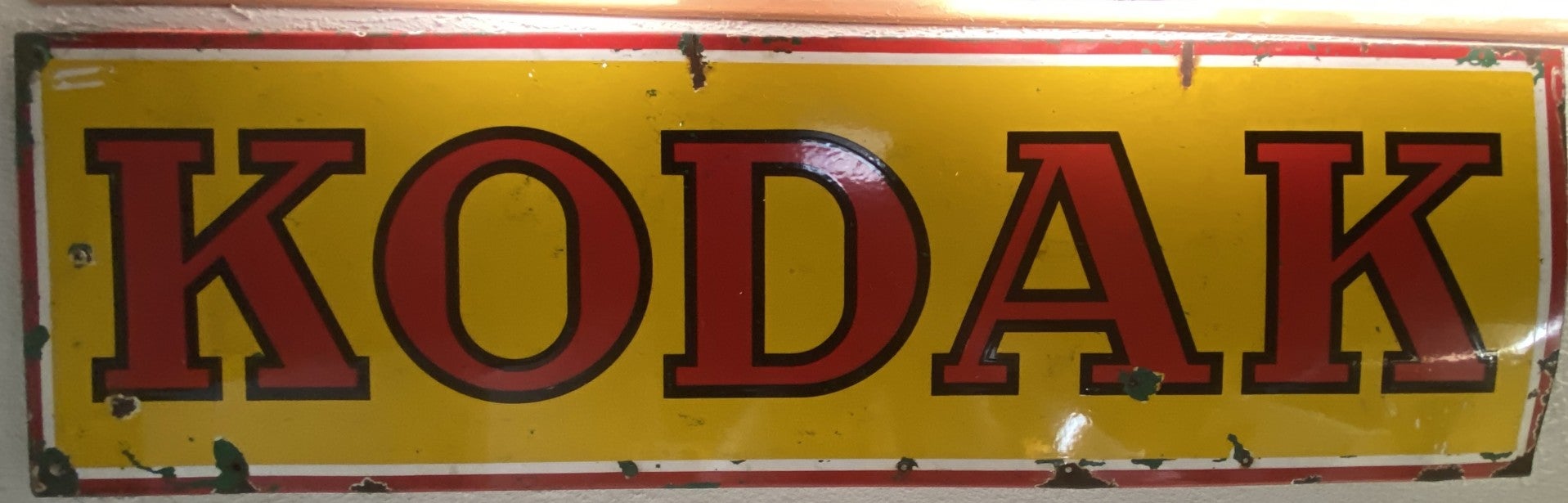
This is an original vintage enamel advertising sign from Kodak, presumably produced in the mid-20th century (circa 1940s-1950s).Made of heavy enamel (porcelain on metal), which was frequently used at the time for durable outdoor advertising at photography shops and drugstores. about 1 meter in lenght
Kodak Sign, New

This is a vintage Kodak advertising sign with the recognizable yellow background and the classic slogans "Make it a day to remember" and "Kodak FILM AVAILABLE HERE". These types of signs were formerly used by shops and photographers to indicate that they sold Kodak products.
Kodak Sign, origional lichtreclame

This image shows a vintage illuminated Kodak advertising sign intended for photo labs or specialty shops. The text reads: "The surest finish for your Ektachrome film". This vintage illuminated Kodak advertising sign dates from the late 70s or early 80s and has an estimated collector's value of €150 to €300.
Kodak Sign, small

This object is a decorative, retro metal wall sign featuring the iconic Kodak Film advertisement.
Kodak Tea Set, japan 1985

This is a vintage Chinese porcelain Kung Fu tea set, released as a special promotional collector's item by Kodak. The tableware is recognizable by the distinctive red and yellow Kodak logos applied to both the teapot and the six accompanying teacups. The set is packaged in the original decorative gift box featuring traditional Chinese calligraphy and a fabric interior.
Kodak Tea pot, UK 1977

KODAK/KODOK CAMERA CERAMIC TEAPOT by THE TEAPOTTERY. Based on the Classic Kodak Brownie 127 camera. Label reads: THE TEAPOTTERY AT LEYBURN, THE YORKSHIRE DALES & KESWICK, THE LAKE DISTRICT, ENGLAND. Size: 8"(L) x 4"(W) x 5"(H).
Vintage Kodak Timer 8239 Red Metal In Original Box

Function: It's a mechanical, wind-up timer specifically designed for use in a photographic darkroom. It was used to time the various steps of film development and print making, such as agitation, developing, stop bath, and fixing, which required precise timing in a low-light or no-light environment.
Appearance: This particular model is easily recognizable by its bright red metal casing, chrome bezel, and classic Art Deco styling, and it features the name "KODAK TIMER" on the dial.
Mechanism: It's a 60-minute analog timer (the dial is marked 5 to 60) that would tick down and likely sound a buzzer or bell at the end of the set time. The small lever or knob at the bottom center would be used to wind the mechanism and set the desired time.
Box: It is shown with its original yellow and red box, which is characteristic of Kodak's vintage packaging. The box often states it is "FOR THE DARKROOM."
These timers are considered collectible pieces of vintage photography equipment today.
Kodak Toonbank schaal (Kunststof)

Counter sign of the iconic photography brand Kodak. The object features the German slogan: "MACHT AUS IHREN BILDERN MEHR." (translated: "Makes more of your photos"). At the bottom, a distinctive rainbow stripe is visible, symbolizing color photography and color prints. This type of promotional material was used in photo shops and specialty stores at the time to draw customers' attention to Kodak's photo service and film rolls.
Kodak Counter display(Glass), 1963

This object is an original vintage Kodak glass counter display, specially made for the occasion of Kodak's 50th anniversary in the Netherlands (1913-1963).
Kodak Counter Display (Glas) 1960

This is a rare vintage Kodak Instamatic retail display from the 1960s, made for the Dutch market. The bright yellow color and iconic logo are typical of Eastman Kodak's historical marketing.
Kodak Filter set 1920-1930
Kodak Shop display 1970

These specific Kodak filter sets were primarily produced in the 1920s and 1930s (circa 1920–1935) Characteristic of this period is the folding case ("presentation case"), which is covered in faux leather on the outside and features a purple satin and velvet lining with gold lettering. At the time, they were sold as luxury accessory sets for the popular folding cameras (such as the Kodak No. 1 / No. 2 Autographic and Pocket Kodak series) and early box cameras of that era.

This is a vintage Kodak shop display / film vending machine made of acrylic (plexiglass), which was originally used on shop counters for the sale of film rolls or disposable cameras.
Kodak Kodaslide Pocket Dia Viewer

This vintage device is an Kodak slide viewer, produced around the 1950s. It is a compact, foldable pocket viewer made of Bakelite or early plastics. You can use it to view loose 35mm slides or film strips by sliding them behind the glass lens. When the flap is flipped open, the lens captures ambient light (or activates an internal battery-powered light) to illuminate the slide from behind.
Kodak Gold 200 Cardboard Sign

This is a rare, vintage Kodak counter display from the 1990s, featuring the German-language promotion for the "Kodak Printsessin". This cardboard advertising board was used in photo shops at the time to promote the photo service and Kodak Gold II 200 35mm film rolls.
Kodak Music Singles:
Kodak Single Heidi Brühl 1967
Edwin Rutten. 1975

The rare German advertising single "Heidi Brühl singt: Memory (Denk zurück)" from 1967. recordsale.de This is a so-called flexidisc (a wafer-thin, flexible vinyl record) that was released by Kodak at the time as promotional material for their famous Instamatic cameras and Super 8 film. The track on the record was composed by and performed with the well-known German jazz pianist and orchestra leader Horst Jankowski.
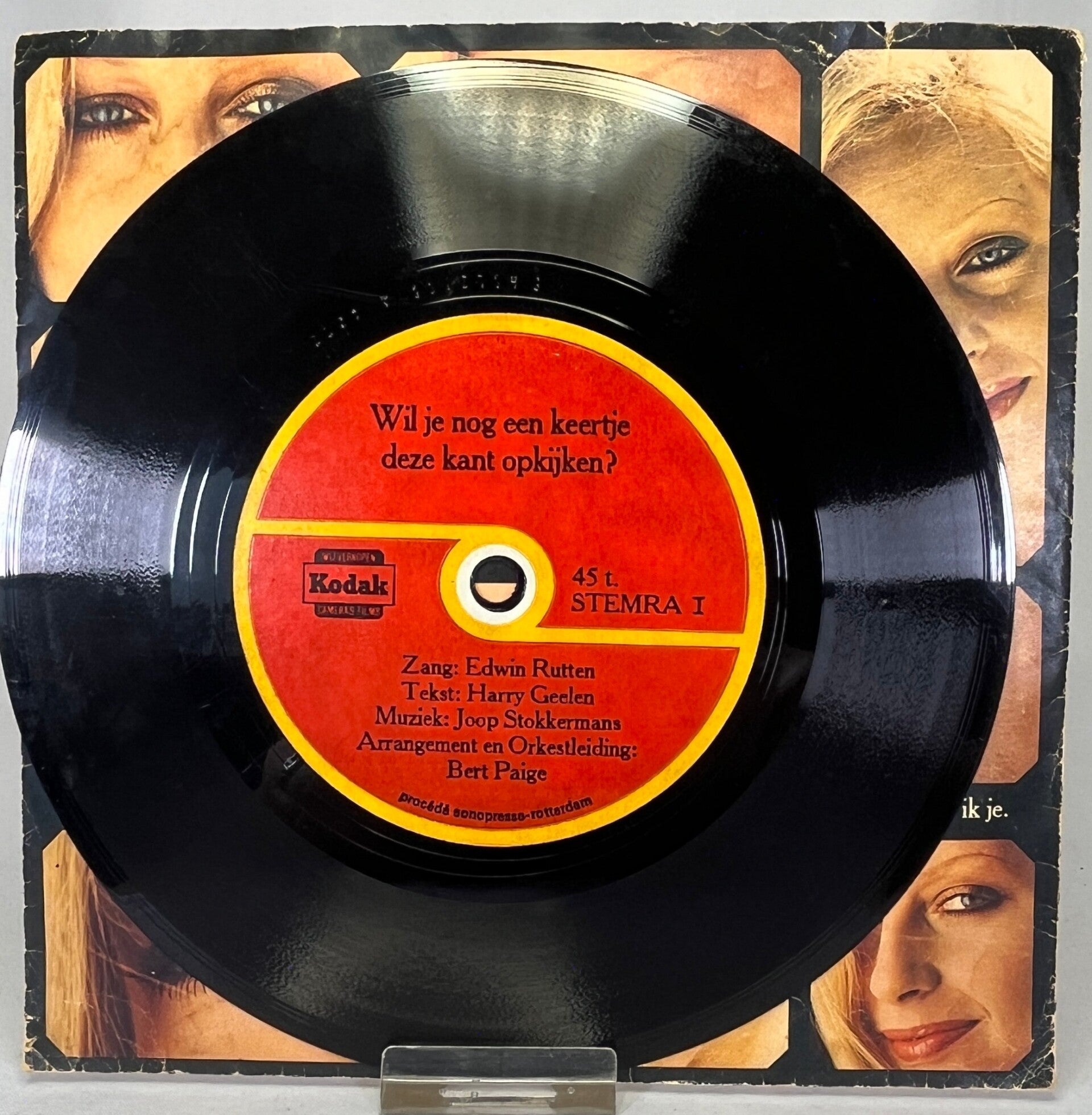
This is the rare 7" flexi-disc single "Wil je nog een keertje deze kant opkijken?" by the Dutch singer and presenter Edwin Rutten (world-famous as Ome Willem). The gramophone record was released as a special advertising and promotional edition for Kodak (to promote their Instamatic cameras).
Kees Van Kooten en Wim de Bie, 1971
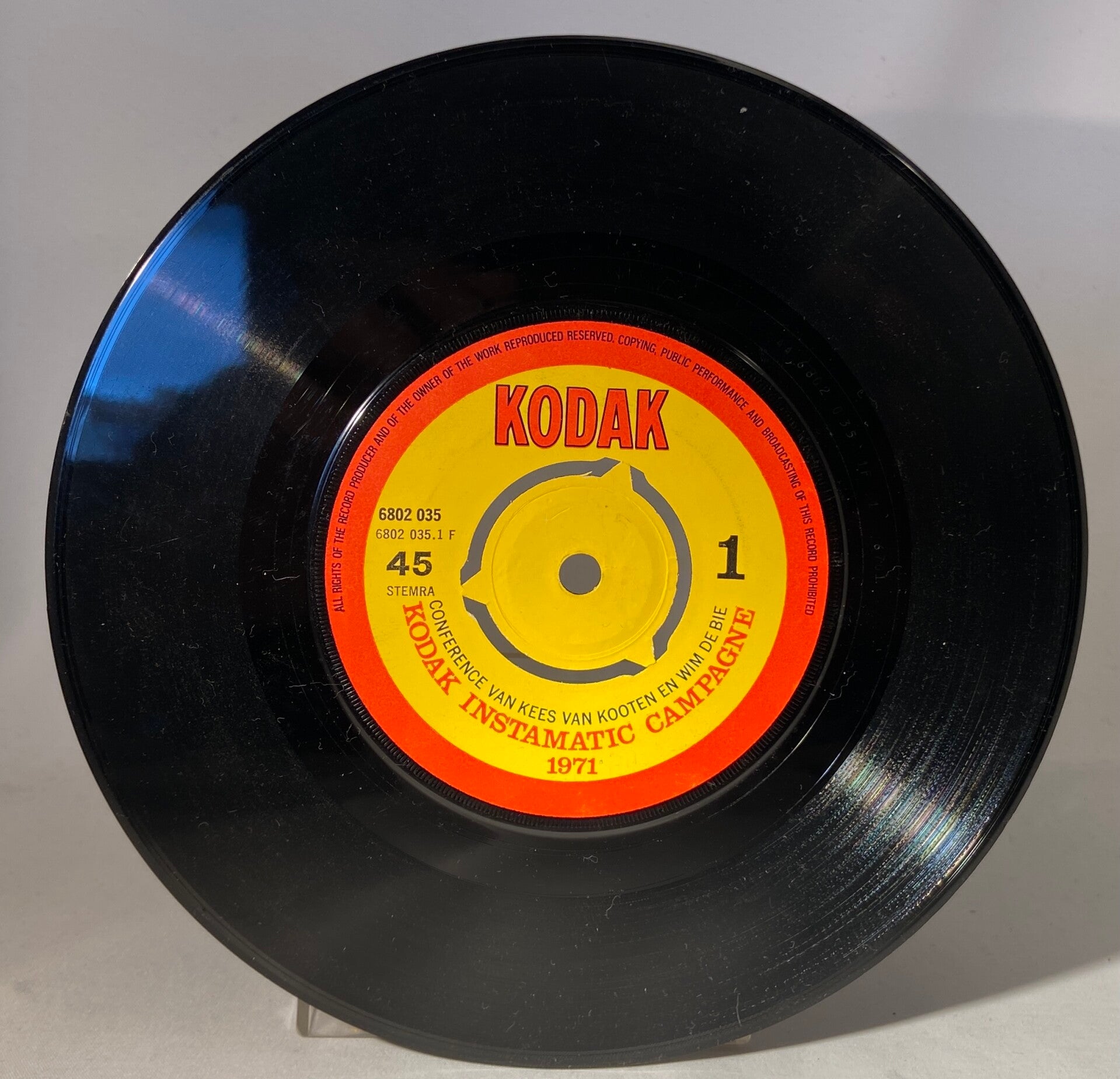
This is a rare 7" vinyl single (45 rpm) from 1971, released as part of the Kodak Instamatic Campaign. The record contains a promotional cabaret performance written and performed by the legendary Dutch duo Kees van Kooten and Wim de Bie. At the time, it was used as advertising material for Kodak's popular Instamatic cameras.
Maak jouw eigen website met JouwWeb